Shiva Poojan 2022 Pune
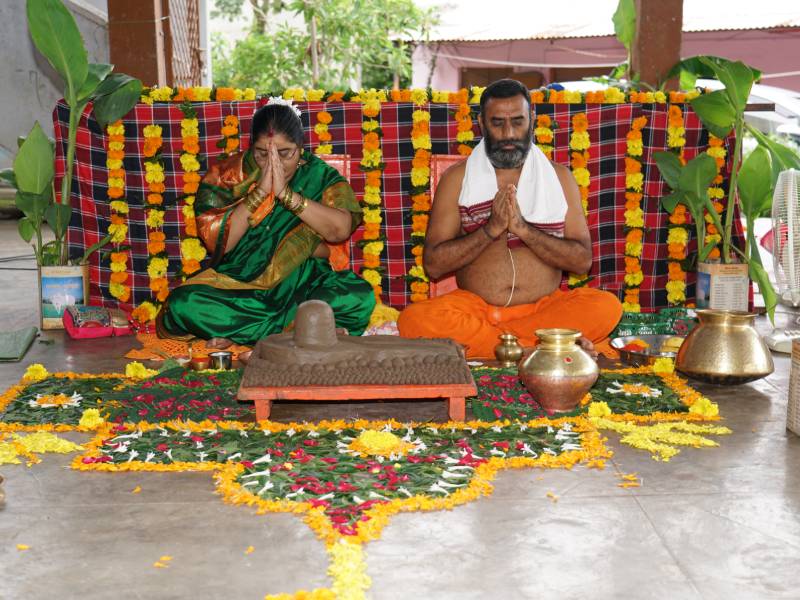
Ritual performances are very valuable in Indian culture. They influence the physical and mental ability of an individual. Unstable mind becomes calm and quiet naturally. Thus, consequently purity and benevolence (सत्त्वगुण) increases. If the performance happens to be in the Śrāvaṇamāsa; (श्रावणमास) according to Hindu calendar, then the सत्त्वगुण i.e. one of the basic constituent of the Creation, reaches it's climax.
In the forthcoming month of Śrāvaṇa (श्रावण) it will be possible to experience Kotiliṅgārcana, कोटिलिङ्गार्चन worship of Śiva (शिव) performed by Bahusomayājī Dīxit Shree Yajñeśvara Raṅganāth Selukar. (बहुसोमयाजी दीक्षित श्री यज्ञेश्वर रंगनाथ सेलूकर.)
Now few words about the deity and the performance. The Cosmic power which creates and controls the Creation is called Devatā, by Ṛṣis. These are described as many but ultimately there is only one. It is just the same as an individual is known by various names- father, son, husband, uncle etc.
Rudra is the Ultimate entity/ truth, having no parallels. Some deities are visible; however some are invisible. Our physical organs need energy, which is generated because of food. The deities, whom we worship, need nourishment similarly. Our sacred texts have prescribed various means for the purpose. Sometimes it is Yajña (यज्ञ), at times Abhiseka (अभिषेक) accompanied with the recitation of the Vedic Mantras. Such performances lead to the wellbeing of the society/ world.
The Eternal truth, which is without attributes, formless, intangible to the senses is beyond description and all - pervading. It is Nigun. Śivaliṅga (शिवलिङ्ग) is a symbol of Nirguṇa in the material world. Liṅgārchana Abhiṣeka
लिङ्गार्चन – अभिषेक is meant for the wellbeing of the society. Śivaliṅga is an astonishing mixture of the endless Cosmic highest- reality, having Saguṇa as its base.
A famous myth from Liṅgapurāṇa (लिङ्गपुराण) tells that once a dispute occurred between Brahmadeva and Viṣṇu as regards superiority. Suddenly a resplendent Cosmic pillar appeared from the water. Brahmadeva tried to find out the upper – end of it in the form of a Swan and Lord Viṣṇu in the form of Boar tried to reach the depth; however it was beyond their intellect and physical reach. They were speechless. This is the attribute of Śivatattva (शिवतत्त्व).
The word Linga means a symbol. The symbol guides us towards the Ultimate reality. One more meaning of the word Liṅga (लिङ्ग) is that in which the Creation gets dissolved.
Worship of Śiva goes back to ancient times. Excavations from Mohen- Jo- Daro have exhibited the idols having three faces and horns, accompanied with some letters carved on it. Many Śivaliṅgas were discovered at Terrakota.
About the Deity in the Veda
Rudra is a minor deity in the Ṛgveda. Only three hymns are addressed to him. In the Yajurveda, Rudra gets prominent position. The fourth and fifth Kāṇḍa of the Taittirīya Saṁhitā ( तैत्तिरीय संहिता) of the Kṛṣṇa Yajurveda ( कृष्ण यजुर्वेद) gives Mantras related to Agnicayan ( अग्निचयन) and the explanation from the Brāhmaṇa ( ब्राह्मण) texts. Thus the Yajurveda and the Rudra have a close relation.
There are two forms of the Rudra. One is terrifying and the other one is agreeable. Agni and Sūrya are related to the fearful form of the Rudra, and the resplendent Moon is related to the pleasant form of Śiva. Both these are the manifest forms of the highest reality.
According to the Shaiva tradition, Creation is a special trait of Śiva. सृष्टि→ creation, स्थिति →sustentation, संहार → destruction, विलय→ dissolution, अनुग्रह → favor are the five modes of functions of Śiva.
The part of the Cosmic power that causes the illusion of the world (माया/ शक्ति) is considered to be the power of Śiva. Śvetāśvatara Upaniṣad (श्वेताश्वतर उपनिषद्) calls it Prakṛti (प्रकृति).
Five faces of Lord Śiva are known by the names Sadyojāta (सद्योजात), Vāmadeva (वामदेव), Aghora (अघोर), Tatpuruṣa (तत्पुरुष), and Iśana (ईशान). These five faces are supposed to be connected with the five basic elements (पञ्चमहाभूत) five sense organs (ज्ञानेन्द्रिय), five active organs (कर्मेन्द्रिय), and five तन्मात्र, i.e. five objects of senses.
The theory means Śiva is all - pervading Cosmic Energy and the whole world is manifest form of Śiva. Śivaliṅga (शिवलिङ्ग) is a symbol of Śiva in this material world. Worship of Śivaliṅga possesses an ancient tradition. There are twelve (12) places known as Jyotirliṅga (ज्योतिर्लिङ्ग) in India. These are sources of Cosmic Energy. Twelve Śiva temples are situated here at these places. Scientists argue that these places are originally volcanoes in ancient times.
Temples of Śiva and Śivaliṅgas exist even outside India. Śivaliṅga has been found to have existed in Vietnam (व्हिएतनाम) in the 9th century.
According to Dharmaśāstra (धर्मशास्त्र), different desires are connected with the specific material of the Śivaliṅga, e.g. Earth, Ether, stone etc.
Śivaliṅga found in Narmadā is specially known as Bāṇa (बाण). In many families it is worshipped. Śivaliṅga has two parts. One is the surface (पीठ) and Piṇḍī (पिण्डी) is supported by it. It is placed on it. It has got ablongated shape. Svayaṁbhū (स्वयंभू) Liṅgas have this type of shape.
Five faces of Śiva are related to five basic elements in the Creation and the five temples are famous in southern part of India.
| Śivalkāñchī | → | Pṛthivī | शिवकाञ्ची | → | पृथिवी |
| Jambunāth | → | Jala | जम्बुनाथ | → | जल |
| Aruṇācala | → | Agni | अरुणाचल | → | अग्नि |
| Kālahasti | → | Vāyu | कालहस्ती | → | वायु |
| Chidambara | → | Ākāśa | चिदम्बर | → | आकाश |
There exists a long tradition of nearly 100 years of Liṅgārchana
(लिङ्गार्चन) and Śrauta Agnihotra (श्रौत अग्निहोत्र) in the Selukar family. The word Liṅgārchana means worshipping a symbol of Śiva -- Śivaliṅga (शिवलिङ्ग).
During the festive occasion daily rituals/ obligatory rituals (like Agnihotra अग्निहोत्र and Darśapūrṇamāsa दर्शपूर्णमास) will be performed along with Liṅgārchana (लिङ्गार्चन). Pūjya Swāmi Govindadevagiri has blessed the performance.
In the programme will feature Pdt. Ganeshwarshastri Dravid, Bhāgavatācārya Anantashastri Muley, Dr Ramachandra Dekhane, Dr. Ravindra Muley, Dr Raghunath Shukla (NCL) etc.
Please join us and experience this rare occasion from 29thJuly 2022 to 28th August 2022.
Please click here to register.
Yours,
Shravanmas Shivpoojan Seva Samiti Pune
Contact: 9890901788, 9822213283, 8308840996,9422331196, 9373332498
Place: Mahesh Sanskrutik Bhavan,
Uppar Indira Nagar last bus stop,
Kondhwa(bk), Pune -411062
Donation Account details:
A/C Name :-Maharshi Yadnyvalkya Sanskrut Vidya PratishthanAC Number:-007230100003326
IFSC Code:- JSBP0000007
Karve Road, Pune
Account type-Current
Donation QR code: